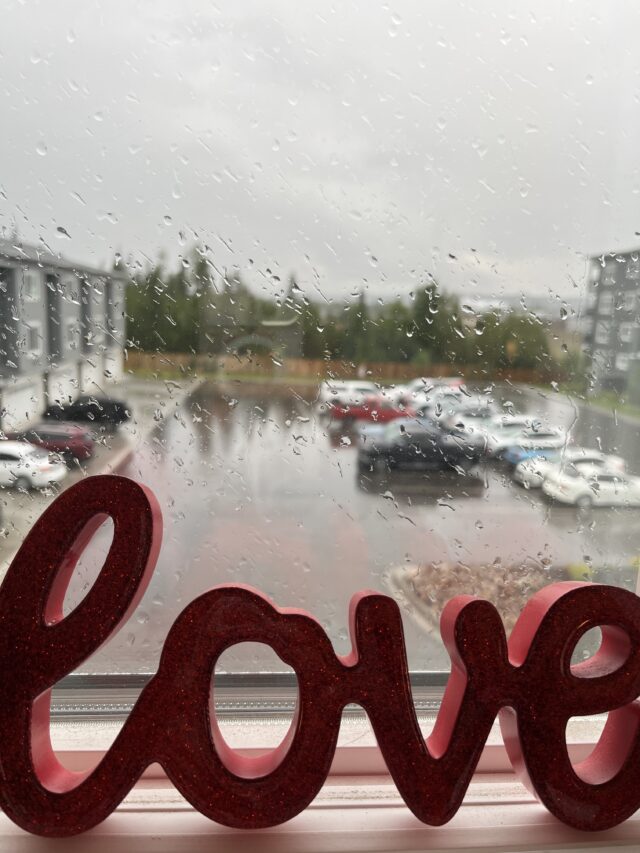
I will say, imposter syndrome is REAL. Understanding my worth is CHALLENGING. And, being ok with rejection is NORMAL. Wow. It has taken me a load of time to figure this out, but I guess that is the journey. I am sitting here on a Friday night, looking out my window and watching a thunder and lightning storm. The metaphor did not escape me. Big changes are a happening, and it’s taken me a long time to accept who I am, love who I am, and love the work that I do. I guess I am going to cite Brené Brown again to say that “I am enough.” I do remember the words of my supervisor saying, “we don’t give out doctorates to anybody… you’ve earned it.” (PS. may not be the exact words, but it’s close).
I remember that it took me a year to tell people I was a doctoral candidate (which meant passing the comprehensive exams), many years to complete my dissertation (because I kept spiralling in the research problem without making much progress until I quit my job, became a school trustee, and realized that my job as a doctoral student and researcher was to answer the research question.). Once all the pieces seemed to make sense (as I struggled with my identity, my value within the profession, and what to do next in my professional career), I completed my research. At that time, I was a sessional instructor (commuting from the Sunshine Coast), I was a two-term school trustee, and my mom was dying (I needed to take care of her).
What can I say? Life was turbulent to say the least, and my sense of self was at an all time low. It’s hard to hear things like, “hey, do you want to publish your dissertation?” from your supervisor. I had no idea what he was talking about. He offered to help and to be a co-author (many, many years ago), and I said, “sure.” I had no clue what this meant or involved. He took the time to reduce my dissertation down to a word-count less than 10,000. He managed to do it, and added his flair to the manuscript to to bring some of the ideas together in its condensed form. Now what? It did take some time to get the manuscript completed, but once it was in my hands to review and submit, I was lost again. What was I suppose to do with this document? Where does it go? Academia is very much what my dissertation was about… being out-of-field, learning-by-doing, and experiential learning. I did submit it to one place, but the editor quickly returned the manuscript to me saying that they did not like the convenience sampling approach and that it needed a literature review. I can say that now, but what I internalized then was, this work is garbage and you can’t read or write. Sounds extreme, I know, but that was the headspace I was in. It was not good, so formative feedback was difficult to receive.
Time lapsed. I could not fathom submitting this work to another journal. First, it was a long manuscript. Most journals accept 5000-7000 words. I’ve attempted to shorten the manuscript and edit it, but I could never get passed the first page. I was so devastated by the editor’s reply that I could not even think about subjecting my work to anyone, despite the blood, sweat, and tears incurred by both myself and my supervisor. I did not have the strength, confidence, or heart to do it. I just wanted to keep the work to myself. So, what did I do? Pursued academia and engage in studies that had NOTHING to do with my doctoral research. OMG. At the time, it seemed like the right thing to do. I loved returning back to teaching, and I love learning about research. I am really enjoying working with others on some research projects, and I am getting some publications out that are aligned to teaching and learning. Lots of what I am doing at the university through teaching, research, and service are related to what I love, but none of it is directly correlated to my doctoral research. CRAZY. Until one day, I went back to that manuscript and realized that my supervisor referred to the literature review in the discussion as a strategy to reduce words, and my student did engage in a form of convenience sampling.
HELLO? I’m not a bad person.
Other life events have happened since then, like ending my marriage, moving to a new place, becoming a full-time single parent, navigating the academia world (and not really doing a good job at it), buy a new place, a new car, a new way of being. Why not through a pandemic in there as well as a strike (that was a turbulent year). The brighter side, my kid just graduated from university and working a full-time job, I am a cat-mom, and I love teaching and learning about math and math education. Ah yes… back to my OG love. I get super stoked attending professional development sessions about math education, and I have opportunities to put my doctoral work into practice. I’m not sure if this is serendipity or that I was always meant to. It’s been an incredible journey to get to where I am today, and YES… I submitted that manuscript to a different journal, that accepted up to 10,000 words, and I feel 1000-times better about this work and realizing that the research is still relevant. I want to do a replication study. This work is interesting to me, and I feel like I’m coming home… in a good way… and it feels GREAT. I have overcome my fears. And, even though I have another chapter, and another chapter to write (with timelines), I needed to take today to submit that manuscript, regardless of outcome.
I feel good. I am not hung up on the outcome, or the feedback. Everything is formative, and I really understand that. It’s taken many learning experiences to get to where I am with this mindset. Not only did coach teacher candidates this understanding in their upcoming and recent publication as a conference proceeding, but also to graduate students I am mentoring and supporting in other ways and roles. But now, I get it. I really understand who I am, my doctoral work, and MY WHY (of which I wrote in my last blog post). This ALIGNMENT has been something that I have always been striving for, and now I see it, I can feel it, and I know it. I feel that the floodgate has opened and now the water can rush through. I want to use the metaphor of a salmon swimming up stream, but my arrival is not my death, but rather the opportunity to lay eggs and spawn birth to new ideas and possibilities. I had to write this blog post soon after I sent my manuscript, co-authored with my supervisor. I know that we are colleagues, but he will always be my supervisor. For that, I am very appreciative. Onwards and upwards… to the next chapter!!
Written by Christine Ho Younghusband, June 19th, 2026 | Comments Off on Overcoming My Fears
June 18, 2026 – Trying to Catch Up on My Reflections
There was one thing that I loved so much when I was teaching in K-12… many decades ago… it was PROFESSIONAL DEVELOPMENT. I loved going to different conferences, I loved learning new things and ideas, and I loved being the Professional Development Representative for our school. And now, I love presenting at conferences, I love attending conferences, and I love connecting and reconnecting with people at these conferences. I just LOVE conferences and professional learning. There is no surprise that my dissertation centred around professional learning, as well did my major papers during my masters program as well. I never thought that I was a “good learner,” but rather, now that I’m thinking about it, I was “not a good student.” Wait a minute, let me unpack that…
I love chatting with my brother and sister who both reminisce about high school and how both of them went to the Mayor’s Lunch. I had no idea that they went to the “Mayor’s Lunch.” I was very aware that my twin-bro won lots of awards, at least a contender for many of them when we were in high school. I’d consider him to be one of the top three students in my graduating class. I knew that my sister loved high school (but she also likes going to the dentist too). Anyway, they were so good at school, that they got to go eat lunch with the mayor. I never done that, nor knew that was even a thing until I was in my 50’s. That is so sad, but also, not surprising. Why would I know about the mayor’s lunch. I think I was above average, at best. I was a solid “B+” student in high school.
I did not find school particularly easy, or interesting. In hindsight, I should have stayed in my typing class, continued with band, and maybe follow through on the Calculus 12 course. I think if I had stayed in all three courses, I could have been on a different trajectory. I did stay focussed on curling, and committed to the sport until the end of grade 12 when my team won the Alcan High School Provincials, and runner-up in the BC Provincials. That was a pretty good year. Reading and writing were not my strength, and as you can see, I kept on pursuing things that I was not very good at… for some strange reason. And, I stepped away from things that I thought I was not good at, caved into my ego’s needs, and quit. Hmm… this finding is very insightful. How can I stay the course?
Fast forward to present time, or at least the last decade, life has underwent much transformation. Call it the midlife-unravelling (named by Dr. Brené Brown), or turning a new page to a new chapter series… LOL. Whatever it was, I needed to undergo these changes to be where I am today. I am currently writing 2 chapters. I never thought there would be a day that I would be saying that, but one I am procrastinating, as the final submission responding to revisions is due in a couple of weeks, and the other needs to be written by the end of summer. This pat-on-the-back is not listing out other major tasks such as organizing the program annual retreat, writing an overdue book review, and acting as an external examiner for a dissertation. Again, these are all good things.
I’m still overwhelmed with some other work that needs to get done in the meantime and the house is mess. Right in the middle of composing the blog post, I had to take a pause and clean the hallway, of which my daughter consumes, do her laundry because I have to for my own peace of mind, and vacuum the floors that needed it months ago. Ahhh… just those little things (aka., huge tasks) frees my mind to really enjoy things like writing and professional development. I loved how I heard on one podcast where the guest said, RESEARCH IS ME-SEARCH. I think I heard that before, but it reminded me that this work that I am doing is also about self-discovery and understanding. One co-author I am working with reminded me that I LOVE PROFESSIONAL DEVELOPMENT. She ain’t wrong.
Strangely, I never considered myself curious, but lately, folks around me are describing me in that way. Huh. I guess I am. You know that I am in the midst of turning a page onto a new chapter because I do feel a level of liberation. I’m not sure if it’s because my daughter has graduated from university and is now working as a full-time nurse, or that I’m engaged in physio and paying more attention to my physical self, or if it’s because I said no to applying for promotion because I know that I am not ready yet. All of these acts are powerful and also play a role in my professional learning. Self-knowledge, according to Parker Palmer, is an important component to good teaching along with knowledge of the subject matter and knowledge of the learners in the classroom.
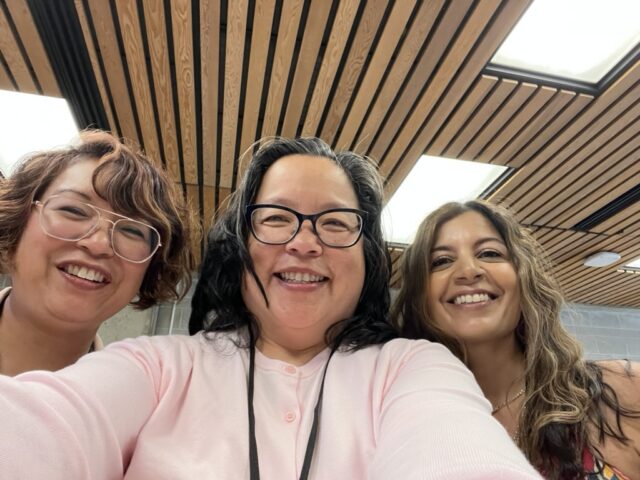
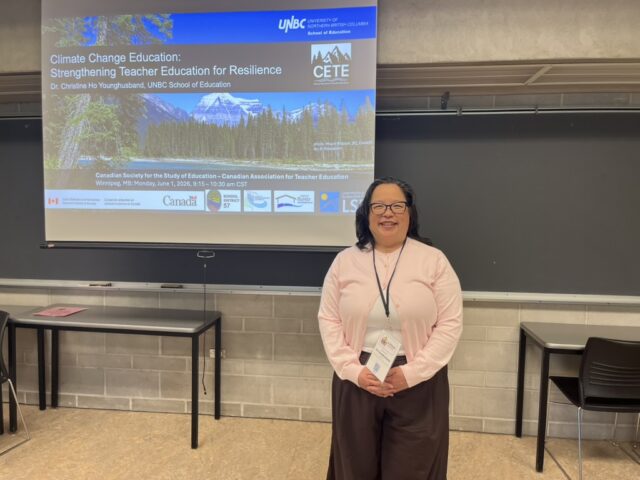
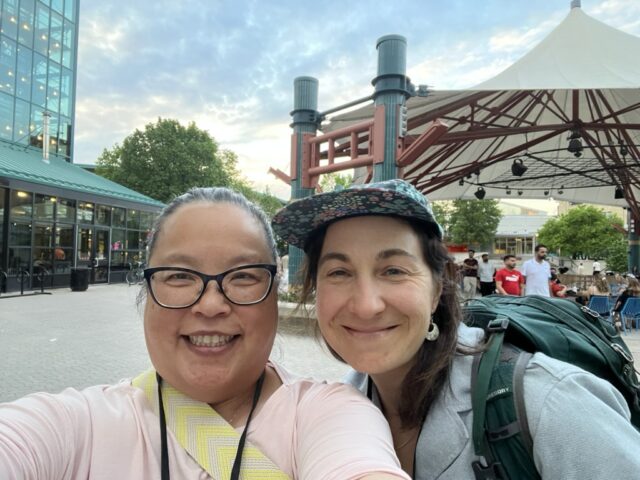
I had such a good time at the University of Winnipeg at CSSE (Canadian Society for the Study of Education) Conference 2026 . I presented twice for CATE (Canadian Association for Teacher Education), and I was the Program Manager for CAARE (Canadian Association for Action Research in Education). It was a good balance between presenting, connecting, and organizing. I had a tonne of fun in Winnipeg. I was so glad that I went there a few months ago for WestCAST 2026 with a few teacher candidates. We really explored the city then. This time, I was focused on the conference, being with good people, and enjoying my time learning from others. I did walk away from the conference feeling like ACTION RESEARCH is m JAM. That’s exciting too. I can’t wait for the next conference.
Written by Christine Ho Younghusband, June 18th, 2026 | Comments Off on I Love Conferencing
March 26, 2026 – My cat found a new passion in Churu
Oh my… I am super late with my weekly blog, so much so that it’s almost next week. That’s ok. There will be something else to reflect on and wonder about. What I wanted to talk about in this blog post is reminding myself what stokes my fire. I find myself, at times, overly excited when I am at presentations and I can honestly feel the JOY busting through my chest. My energy is up and I just get excited about the possibilities. I just get JACKED-UP when I am at a ProD workshop or conference. And yes, that topic is MATH.
Let me be clear. I’m not a math-nerd. I’m OK at math. In some ways, I wished I was math-bionic. With respect to pure-math at the 300- and 400- level, I would need to return back to university to find the love in different types of mathematics. I am not 100% sure if I can say that “I love high school math” or “elementary math” per se. The content itself can often seem disconnected to the real world and it’s hard to believe that math teachers from K-9 are primary working towards mathematics to learn calculus. Yup, it’s true.
Now, I’m getting into MY JAM. I love the policies, the pedagogies, and the politics of math and math education. I am so drawn to the idea of math identity and math efficacy. Moreover, I am so enamoured by math teacher efficacy and math pedagogy. I love how people interpret and translate the curriculum. I love math education teachers and experts who share their ideas and exude a love for math. I am so curious and deeply invested in policies in math education and why it matters. It’s all a puzzle to me. It’s super FUN!!
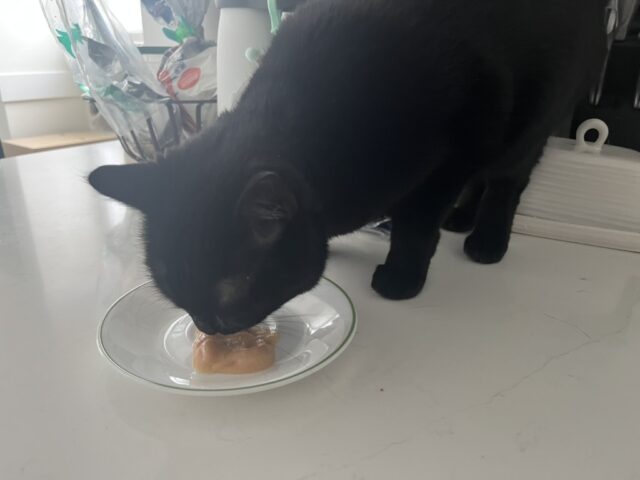
So, it’s strange to look back at my photos to find an image of me and my friend (i.e., selfie… on-brand) or even a food pic of my lunch (i.e., also on-brand). Nope. I found a picture of my cat eating Churu within 30 seconds. I used to give my cat Catit tubes, but saw an AI cat on Reels promoting Churu. I thought I would try this brand with my cat and she has never looked back. My point is, she found her JAM too. So, the picture seemed appropriate for this blog post. There is likely no pic of lunch because I was so engaged.
Oh my goodness… we just talked about MATH, math education, and math policies. We chatted about math efficacy in teachers and ourselves. We talked about the proposals we each wrote with hopes of the editors from UBC to publish a book on Indigenous Math K-12. I was brought home. It was a very familiar feeling and I was so grateful to have this 2-hour conversation over fish tacos about math and math education. I was so engaged, excited, and interested. It’s conversations like these that boost my math efficacy.
I am finding as an academic that I am exploring everything about education in terms of leadership, identity, and pedagogy, but I am not centred around mathematics. What is that about? I don’t ask this question in a judging way, but rather in a curious one? What happened to my doctoral research? What happened to continuing that research program? What happened to my math embedded project? Why aren’t I exploring that work further?
This lunch conversation and how I feel about math, math efficacy, and math identity cannot be underestimated or ignored. I remember one student asking me if it was ok if they took my research idea math stories. I said, OK. This convo has left me thinking. I need to really dig deep (well not that deep, I’m there) and be truthful about what I fear about and why it matters. Being in my JAM matters to me and I need to stoke this fire.
Written by Christine Ho Younghusband, March 26th, 2026 | Comments Off on Feeling Stoked About Math
I could not find a picture for the life of me for the blog post. So, why not a food pic of my breakfast from this morning, of which, my friend bought for me. It was delicious and unexpected. We sometimes go out for breakfast. It’s something I like to do, in particular, have a “hotel breakfast.” As a kid, we NEVER went to the hotel (or motel, for that matter) for breakfast. And, don’t even consider room service. It was not a thing that my parents did, and I see why. It’s expensive. Why not go through the McDonalds drive-thru to get a breakfast combo? (TBH: I did that on Saturday… LOL). Nonetheless, I wanted to try a new place in Prince George. We often go to the WhiteSpot, of which I do enjoy. My friend recommended Grama’s Kitchen at Grama’s Inn. I was game, and I heard some folks talk about this place, but never went.
On the way to the restaurant, my friend tried to describe the experience I was about to embark on. She said that the service is lively and entertaining and the food is homestyle. I was open and wanted to try something new. When we arrived to the Grama’s Inn, I did not realize that the entrance was on the side. The parking lot was almost full, much like the restaurant. It was a little establishment with lots of light. The two servers were very lively and entertaining, but also personal. They recognized my friend when she entered the restaurant. We found a table and went with the flow. There was a distinct rhythm to the place. I loved the natural light coming through the windows. It was super sunny this morning. And, I appreciated the homestyle service and food. The place was hopping the whole time we were there.
I was also surprised that we both knew people who were at the restaurant. It was clearly a place to go for the locals. As you can see from the photo, the portions are huge and the food was very delicious. I even got raisin bread for my toast (my choice and never had that before with my breakfast) and I chose the shredded hashbrowns, sunny side up eggs, and sausage. One of the things I do like about my meals is lots of variety and lots of choice. This experience met that criteria in spades, as well as being a “hotel breakfast.” There is something that’s heightened for me when I can have not just breakfast out, but at a hotel. This place did not disappoint and I am likely to come her again. I am so glad that my friend took me there. I’m not sure if I would have went on my own. It was a good day to celebrate International Women’s Day.
Why does this all matter?
I feel that this breakfast experience serves as a metaphor of my week and weekend. I have a zillion things on the go (and I am not complaining because it is work that I feel very aligned to) but there are only so many hours in a day and week. This week was Weaving Words, an Indigenous writers’ festival in Prince George. I have heard about this event over the last few years, but never went. This year, I felt compelled to go. A good reason why is, my friend, Carolyn Roberts, who was one of the writers and speakers of the event reached out to me to say that they would be here in Prince George and wondered if we could connect. I did not realize that she was going to be one of the speakers (until I looked into it). We went out for dinner at the beginning of the week, and I went to one of her events on Wednesday that she was speaking at and then to an evening event at Omineca Art Centre. I bumped into another friend there as well, and we listened to a few writers that night, including Richard Van Camp.
Unfortunately, I could not attend all of the events for this writers’ festival. I had to work, I had meetings, and I was teaching. Time is a premium lately, and I decided to go to the beading session at the Two Rivers Art Gallery with my daughter on Friday afternoon with Crystal Behn. I loved that session. I came to that session not in the greatest of moods and beading is a good teacher. I did not follow the pattern that was suggested, unlike my kid. I wanted to make a heart, and yes, it looks blobbular and free-wielding. At the end of the session, with some homework to do, a person at the workshop said, hearts are one of the hardest things to bead. HUH. That tracks. I’m pretty happy with the process. You can see over time in the beading, my energy shifted from a form of “grumpiness” to one that was more peaceful and accepting. I was not planning to go to the evening event at Books and Company, but my friend encouraged me to go.
No regrets.
I never went before. Saw some familiar faces and I was sitting in the front row. We got to listen to Richard Van Camp and Katherena Vermette speak and read to us. It was AMAZING and I was such in awe with how clear and confident each of them were about who they are, where they are from, and their craft. I enjoyed Richard talking about how he writes and what inspires him. I have been part of a couple of workshops with Richard as Zoom sessions, so seeing him in person was absolutely a bucket-list experience. Consistently, he is so generous in helping others in their writing journey, and once again, he offered a “one month” opportunity to send him a “what if” piece of writing, and he will provide feedback on your work. I don’t know how he does it, but I always appreciate his invitation. With Katherena, I just enjoyed her reading and embodying her poetry. I loved watching her move her hand and read her words with animation and ease. She took me on a ride with her words, and I was so honoured that she was here in Prince George to share them.
What a way to end the work week… despite the volume of unread email in my in-box… and all of my intentions of what I wanted to achieve this week. I just loved that I was able to see a few events from the ‘Ut’loo Noye Khunni – Weaving Words Celebration that highlights Indigenous storytelling in its many forms. Often professional learning is one of the first things that gets struck from the list of things to do. I am so grateful to at least attend a few sessions and not foregoing the whole event, like I have in previous years. Thank you to all of the artists, organizers, and volunteers who made this event possible. You have inspired me in many ways, and I hope that I can also find the courage and motivation to share that deep love that you have about where you are from, what you do, and who you are. The joy that you have shared and demonstrated will be in my memories and my heart. Thank you for your generosity and welcoming us in.
Written by Christine Ho Younghusband, March 09th, 2026 | Comments Off on Things Are Changing
I am not sure where the first two months of 2026 have gone to, but here we are. It’s time to recalibrate and delve into a “new start” to the new year. There are a million things I need to do, but I will continue to honour my time on the weekends. This form of REST is honouring and self-preserving. It’s a practice that I did not do when I was teaching in K-12 and for the first handful of years when I started teaching at the university. As much as I thought it was something that I needed to do to be viable and valuable, it took me several decades to realize that I am important and valuable too. I needed to re-navigate my life so that it would or could be sustainable. A couple of years ago, I almost burned out in January and I thought that I needed to respect my health and wellness. In doing so, I needed to figure out who I was, what’s important to me, and do what I wanted to do (not what I thought I needed to do). It’s taken some time for me to figure this out.
For example, today was a gorgeous day. I was inspired to get outside and go for a walk. I needed to connect with the land and place. It’s something that I don’t do that often, but today felt different. Maybe it’s a day for renewal, but I wanted to enjoy the sunshine and make the most of my weekend. I know that I have a billion things to do, my health and wellness are important to me. I loved getting outside and I predetermined a route for me to participate in, with a brief pitstop at the local Tim Hortons. I enjoy a cup of a medium dark regular coffee (and I needed to use the washroom too). Seemed serendipitous, and I even bumped into a former student from last semester at the restaurant (who gave me a couple of chocolates to complement my coffee… which were delicious). I enjoyed my time at Tim Hortons and on my walk, listening to my podcast. I loved the walk and coffee too.
I am also enjoying my time blogging tonight. Normally, I would be prepping for my two Monday classes, but the students are currently on practicum. It provides a little break from the enormity of my teaching schedule, but I continue to teach the undergraduate and graduate courses I am teaching as night classes on Tuesdays and Thursdays. Another thing I enjoyed doing today was cooking dinner for me and the kid. My kid is currently doing clinical, which involves 12-hour shifts. It’s nice to have dinner ready for her today and I was pleasantly surprised that she enjoyed the veggie fried rice. I thought she would not have any of the fried rice, and I would be left with days of having this veggie fried rice. Apparently, it’s not the case. She enjoyed the lemon chicken, but was not a fan of the frozen veggies. Two out of three is not bad. I felt like tonight’s dinner was a WIN!!
As we delve into the new year, I am having second thoughts of my #OneWord2026. Initially, it was PRACTICE, but I’ve been feeling that it should be JOY, instead. Maybe it can be PRACTICE-JOY… a hyphenated word. That seems reasonable. It makes the word “practice” a bit more specific and intentional. Hmm… I like that. There is nothing I like more than a reflective practice. Blogging for me forces me to practice writing, but really, writing is thinking. Getting to a place where I can elaborate on my #OneWord2026 has turned out way better than I expected. I feel “joyful” and happy with this adaptation.
YES… practice-joy. I can do that!!
Written by Christine Ho Younghusband, March 01st, 2026 | Comments Off on Changing My One-Word
Just returned home from my trip to Winnipeg. I went to present at the WestCAST 2026 conference at the University of Winnipeg, but also support and mentor 3 teacher candidates from the UNBC Teacher Education program to present as well. What an amazing job the conference organizers have done to make this event possible, memorable, and incredible. I had a wonderful time, and I believe that this event will be one that the teacher candidates will never forget. The kind of thoughtfulness, organization, and orchestration were outstanding and I was so impressed by the number of attendees and quality of the presentations as well. The UNBC teacher candidates all did an amazing job in preparing for and presenting at the conference. I loved how personalized each inquiry was and how they were able to present their work that was meaningful to them and reflective of who they are. I am so proud of them. As for me, I did A LOT of OVER THINKING and preparing for my session… and I have no idea why???
I was definitely noticing that I was pouring a significant of time in this presentation and I approached my presentation like I did when I was a school trustee and I was writing a speech. It was so important to stay on time, but there was so much to say. Unfortunately, in speech writing, I lost the “pragmatic” or personal approach to my presentation. I tried to blend a bit of ad libbing during my presentation, but I went a bit overtime so I quickly rushed the end. Anyway, all went well and the group that was following my paper presentation would really see what I was trying to say… so much so, they were able to ad lib their work and incorporated what I was saying into their presentation. That was a true compliment and I loved what they had to say with a student led initiative in Indigenous Education at the University of Calgary at Werklund. I feel very lucky. The photo below was a posed picture taken after the conference. Sad, I know. I did not take a good photo when I was presenting, so I wanted to take one posed. What was amazing about this photo was, the teacher candidates I was working with made it possible. Very grateful.
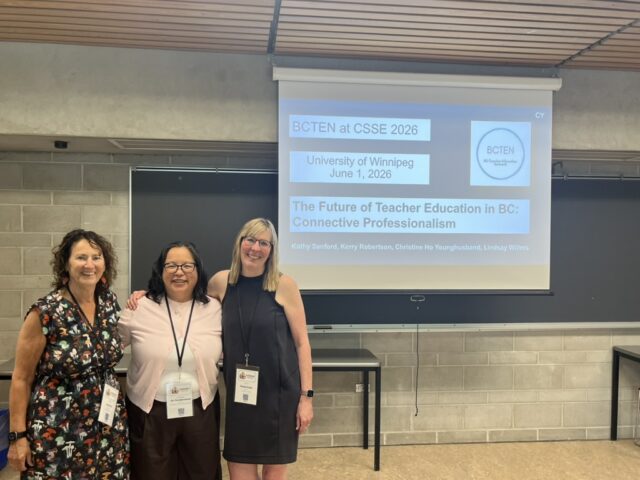
I had such a good time at WestCAST 2026. I loved that I got to present with some colleagues from BCTEN (see image below) about Connective Professionalism and we just riffed off of each other during that presentation. I made the PowerPoint for the group and we collaborated after discussing what we wanted to talk about and after a follow up meeting to decide who was going to speak to which slide. What was fun… or amazing… about this presentation was, although we had “assigned” each other which slide we would speak to, we each created space for one another to speak and add to what each of us had said about our slides. It was, in essence, us modelling connective professionalism and the process of the Métissage that we had co-created for WestCAST 2025 at SFU. I just loved working with these folks and how joyful working together can me. I love BCTEN and the work we accomplish. I feel so wonderful about knowing who I am and understanding what’s important to me. These people are important to me an the work we are doing. I am so happy to be part of a group where we can lift each other up regardless of role of institution. It’s extraordinary. I am thankful to be a part of BCTEN and for these people.
I did not know what to expect from Winnipeg or from the conference, but overall, I am very thankful for everything that Winnipeg had to offer. Not only did I have the pleasure to coach and mentor three amazing teacher candidates from the UNBC teacher education program who volunteered / expressed an interest in presenting at WestCAST 2026 (see images below), but also for all of the fun things we got to do together while at the conference. We went to the Forks, a beading shop, the Canadian Museum of Human Rights, and Festival de Voyageur. The keynote speaker, David Robertson, resonated with all of us, and I think we each did a bit more shopping than we had anticipated. I think what surprised me the most, was reconnecting with folks in teacher education (i.e., from UBC, UVic, and SFU) but also folks who are from Winnipeg. I loved connecting with members of the WestCAST 2026 organizing team, and I got to bump on to a friend and former school trustee colleague who is currently the president of CSBA (no photos). I love my career in education, and the teacher candidates made it known that they were impressed with folks who know me. I said, you have to make your teaching career what you want it to be. For me, human connection was important to me… as a K-12 educator, school trustee, and now academic. Connecting and networking with people make my work fulfilling, FUN, and fruitful. PS. love conferencing!! I’ll be back in May, Winnipeg.
Written by Christine Ho Younghusband, February 21st, 2026 | Comments Off on Returning from WestCAST 2026
A return back to school… with classes on Monday, January 5, 2026 and Thursday, January 8, 2026. My Wednesdays class does not start until next week. I had plenty of meetings this week and I am anticipating more to come next week. It was an excellent jump into the new year with a deep dive into my teaching term with so much more on the go. One of those things I had to tackle this week was filling out my first FRASP for work, that is a Field Risk Assessment and Safety Plan form. I tried to do this last year, but I felt so flooded. It’s a shift in practices at the university and taking students off campus has become a little more challenging, even though they are adults in our program.
It only took a few hours to fill out the form, get confused, ask a colleague for an exemplar, go back to the form and do my best to complete the form. The questions seem not adjacent to taking students to a K-7 school for classes versus somewhere outdoors or at a health care facility, but this form had to be completed and I was committed to do so. The next day, I went to the university to ask teacher candidates in my class to sign the form as well in addition get signed approval from the Chair and Dean. It was a process, and admittedly, it’s 99% complete. I have one more student to sign the form, but I have been approved to start in-situ earning at Harwin Elementary on Monday. Yay!!
Another aspect of the FRASP is for the supervisor (aka., instructor) to have their first aid certificate. Oh my goodness… I needed to get this done before Monday’s class… and when I was getting the formed signed, it was Thursday. No pressure, right? I looked online for Basic First Aid courses in Prince George. I had to try. And yes, there were a couple of classes I could take. It turns out that they program has changed since I had taken it last (i.e., 2 decades ago) and it’s now called Basic First Aid versus Level 1. Nonetheless, I signed up for the Saturday class knowing that that I had to pass for the FRASP, in-situ learning at Harwin, and compliance to my course syllabus. No pressure.
Many, many years ago… I used to be the first aid attendant at my high school. I did that role for years and had to be trained in Level 2 first aid (now called Standard First Aid). Back then, I did quite well in those first aid classes. They used to be a week long and I got time off work to train. Now, that course is only 2-days long and I can imagine, very crammed. We practiced a tonne in those courses, and what I had appreciated about first aid was the logic, the protocol, and the sequence of events that are needed to save someone’s life as the first responder. I like the rigour. Maybe I missed my calling?
Sadly, I was never good at biology. I might attribute that to my high school and university experiences in biology. High school involved rapid note taking via the ongoing scroll of the overhead notes (and the ink was so faint, I could never read it. Or the politician who said, here’s the textbook and there will be weekly tests on the subject matter. Or the professor that talked about dirt. Truth be told, I did not like dissecting a cow’s eye ball, a preserved fetus pig, or freshly killed rat. Not a fan. I like the care aspect of first aid, and maybe making a difference (hence, education). Even when I took care of my mom on her last days, many health care workers asked me if I was a nurse. I said, “no, I am a teacher.”
Anyway, I took the Basic First Aid Course in Prince George. From 8:30am to 4:30pm on my “be a person” day (aka., Saturday). I noticed the length of time of the day. It’s very much like my classes on Monday… so, it is possible. Hmm… but admittedly, an endurance test and there was a lot of content. We did not do a lot of practice compared to what I had remembered from Level 2 decades ago, but I needed a 70% pass on the test, which was multiple choice and held at the end of the day (i.e., 4pm). There was no pre-reading, and the course was primarily direct instruction, PowerPoint, the odd reference to the books, and some demos and practice. I was not sure how I would do on the test.
There were so many acronyms and things to remember. As mentioned, biology was not one of “my things” because of all the names, terminology, Latin… and I know that my brain can be a sieve. I really tried to pay attention during the day. Some things were repeated, but you never know how much you know, until you know. We got the test form at 4pm. I am such a slow reader. I did not want to miss, misread, or misunderstand anything. I think I was on #10 out of 30 and people were finished and getting their test marked. I was trying to self-regulate and focus on the test. I was the last or second to last to finish with 9 questions I was unsure of. In the end, I got 30/30. Woohoo!!
Written by Christine Ho Younghusband, January 11th, 2026 | Comments Off on Missing My Calling
First, I would like to acknowledge that today is NATIONAL BLACK CAT DAY. I am feeling super proud and excited. It’s the first one I have celebrated. Simon joined our little family when I moved into my new place last year in November. We have not been in this house yet for a year, and we have the opportunity to celebrate black cats, more specifically, Simon. She moved into the house on the first day we got possession of the house and she even slept overnight at the house with the kid. She welcomed her new home and we could not imagine life without her. You you, Simon!! It’s your day!!
Second, I was planning to write about my weekend at Vancouver. I went to the CATE (Canadian Association for Teacher Education) Fall Working Conference 2025 at UBC. Because I was so budget-conscious, I opted to leave on the 5:30am flight out of Prince George on Thursday and taught my 8:30-11:20am class remotely from the WhiteSpot restaurant at YVR. Aside from spending a fair amount on UBER and taxi, and early morning start to the day, I really enjoyed the CATE Working Conference. The working conference is intended to be formative, supportive, and mentoring to early scholars (and experienced) to publish a chapter. The topic of this book is about relationality and place-based or land-based learning. I had submitted a proposal in the summer to co-author with 3 recent teacher education graduates. We submitted twice to ensure a clear connection to teacher education and we were accepted to participate. That said, the three “new teachers” were not able to attend the working conference, and I was there to represent the crew. Admittedly, I was not sure what to expect and I did spend some time re-navigating our proposal in terms of approach and methodology. We were grouped with “Working with Indigenous Communities.”
From what I understand, at this point in time, there is a potential to have 26 chapters in this e-book. That means, there were at least 26 submissions to participate in the fall working conference and thus, we were all subdivided into small groups based on theme or commonalities. I thought I would have been put in the “pedagogies” group, but that was not the case. The small working groups are revealed at the conference at the beginning of day 2. The first day was more about gathering and listening to the first keynote speaker, Dr. Jan Hare, the Dean of the UBC Faculty of Education and new Canadian Research Chair for Indigenous Pedagogies. She shared part of her recent work and presented on “Shifting the Curricular Landscape of Teacher Education Through Land Education.” The talk was thought-provoking, and then we went out for dinner at a restaurant on campus. Day 2 was the REAL working day, and Day 3 was more about finishing up any work on Day 2 for any of the small working groups and then reconvening to share our project, feedback, and next steps with the entire group. It was a fast 3 days, and I loved every minute of it. I loved connecting, learning, and feeling connected.
Finally, the heart of this blog post (aside from National Black Cat Day), will focus on Day 2. When I found out my group and theme, I was not certain if I was in the right group. We started Day 2 with a quick check in and then we went into our small working groups. After a few quick introductions, we started to go in numerical order (each blind proposal was numbered) to provide feedback to each author. We were strategic and proceeded to give each author group 18 minutes or so with feedback and discussion. Our small group is the photo above. As each paper proceeded, we started to build up lots of momentum. Each paper topic was so interesting yet interrelated or at least relatable to each of the papers/authors. We had rich feedback and discussion on each proposal. When it came time to stop and watch a panel that was being video streamed in, we opted to keep going with the feedback discussions. Of 7 author groups, we finished 4 in the morning, and then 3 in the afternoon. I felt that we honoured each of our proposals and provided feedback respectfully and wholeheartedly. I was certain after our day together that I was in the right group. I feel very happy and grateful. I could feel the joy growing amongst us.
Midday, we had a wonderful presentation by Dr. Jennifer Tatabe from the University of Auckland, providing a talk titled, “Shifting Ground: Exploring Place and Equity in Aotearoa New Zealand.” It was a super engaging talk and it’s a phenomenon that’s happening everywhere. I loved that talk. Before lunch, UBC Faculty member, Indigenous scholar, and teacher educator Marny Point spoke to the whole group about the territory and the First Peoples Principles of Learning. Even though it was originally intended to be a walking tour, the RAIN was relentless. LOL. All is good. She gave each of us a piece of cedar from her back yard. I just loved it. And, I was reminded of the First Peoples Principles of Learning and the work was are doing in BC education. I also appreciated the dinners out on Friday night at UBC and on Saturday at Hydra in downtown Vancouver. It was an excellent opportunity to connect and meet new people. There were many familiar faces, and many more to meet and learn more about. In the end, I had a tonne of fun and learned lots.
On Friday, I was having a conversation with a colleague and he was sharing a story about how he met a particular person. I said it was SERENDIPITY (definition: the occurrence and development of events by chance in a happy or beneficial way [Google]). Ooo… I love that definition. He said, it was RELATIONAL (definition: concerning the way in which two or more people or things are connected [Google]). I was taken a back by that response, but I don’t disagree. Throughout the weekend, I continued to think about the SYNERGY (definition: the interaction or cooperation of two or more organizations, substances, or other agents to produce a combined effect greater than the sum of their separate effects [Google]) forming within the small group and pondered the notions of relationality and serendipity. I am left to wonder, could it be both? Maybe it’s not one or the other, but the intersection between the two terms. Nonetheless, I loved the weekend and feel VALIDATED, seen, and heard at this conference. Thank you small group, and thank you to the facilitators, presenters, and authors for making this event so wonderful.
Written by Christine Ho Younghusband, October 27th, 2025 | Comments Off on Serendipity Semantics
Although I have been at the university for 7-years, I am term faculty. My role at the university is primarily teaching with an 80-20 position, that is, I am teaching 80% of the time and 20% is service. I was recently renewed with a 3-year contract and I am very excited about the next three years in terms of what I will learn and accomplish. Research is not explicitly part of my position, per se, but I continue to hold the rank of Assistant Professor and would like to learn more about research. Today, I attended a session at the university designed for “early career researchers” or ECR. This initiative is a partnership between the Office of Research and Innovation, Faculty of Human and Health Sciences, and the Health Research Institute. The School of Education is part of the Faculty of Human and Health Sciences, so I am able to attend these events. This session was my second ECR gathering, and both times they hosted a panel and I’ve attended the sessions in-person. I am so grateful for these sessions.
What I have enjoyed and appreciated about the ECR gatherings is the way the host and panel members can humanize and demystify the research process and expectations. I felt at ease during these sessions and I cannot express the value of having very seasoned researchers describe h0w they approach grant deadlines and research writing in today’s session. The stories were very relatable and their words of wisdom and advice were well taken. I did not expect to take notes, but I did. Also, I found myself very inspired to look at some of my work and move forward with some pieces and not procrastinate any longer. Honour your writing time, find peers to provide feedback, and submit grant applications in early were a few tips that I took to heart. It took a few years to figure out the university work culture in comparison to K-12 schools, and I feel the timing of these gatherings have been serendipitous.
No shame. Ask questions. Focus on the learning. Makes sense. I loved how panel members shared their personal stories, professional experiences, and pertinent examples to answer a series of questions set prior to the gathering. I felt very connected with their candidness and compelled to return back to my work. We all feel imposter syndrome and knowing that this is a normal occurrence, it created and invitation to try. Members participating online and in-person also asked questions that related to former documents, GRA hirings, and participation in review committees. It’s amazing to think that 1/3 of the faculty members at the university are ECR’s or new to the university. These ECR gatherings are timely and responsive to what new researchers need. Finally, my guard was disarmed when they promoted and encouraged folks to participate (and re-participate) in writing retreats, grant writing workshops, and communication with the Office of Research and Innovation. EVERYONE WANTS TO HELP. A wonderful message. I feel motivated to keep going.
Thank you to the Office of Research and Innovation, Faculty of Human and Health Sciences, and Health Research Institute!!
Written by Christine Ho Younghusband, July 23rd, 2025 | Comments Off on Feeling Inspired and Motivated
June 1-4, 2025 – Canadian Study for the Study of Education
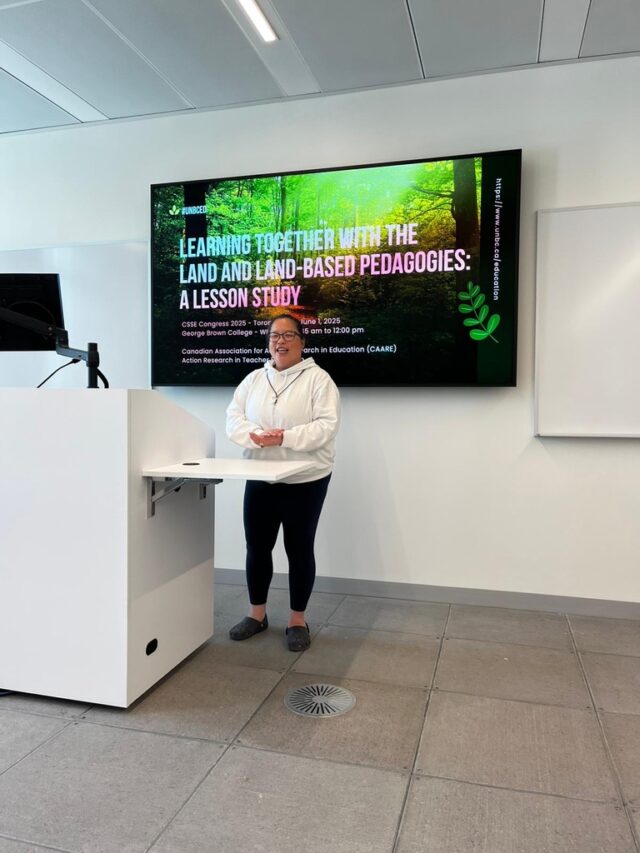
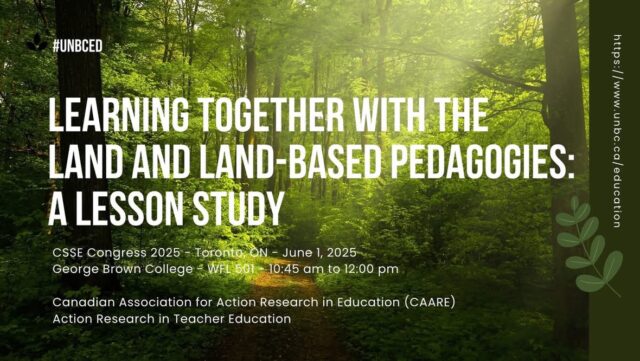
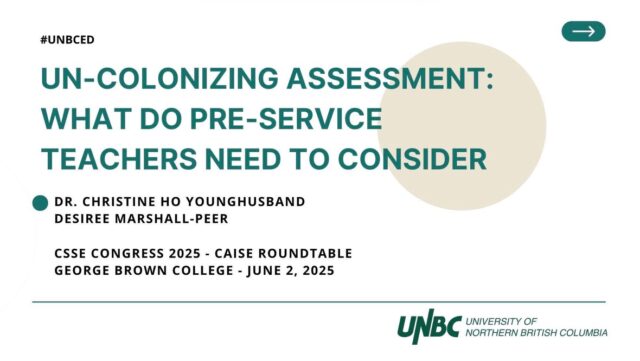
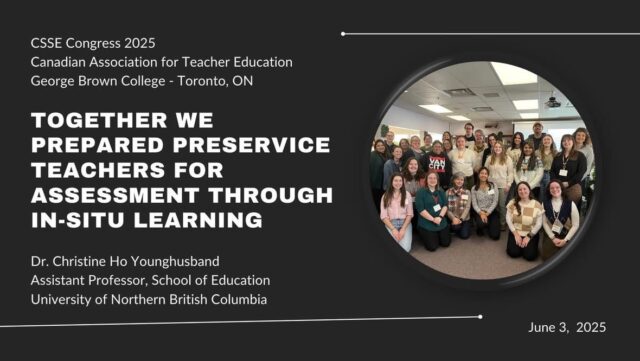
I am so grateful for my friend who took a photo of me presenting at CSSE 2025. I presented 4 times and I only had photos taken of me from my first presentation at CAARE (Canadian Association for Action Research in Education). I also presented at CNIE (Canadian Network for Innovation in Education), CASIE (Canadian Association for the Study of Indigenous Education), and CATE (Canadian Association for Teacher Education). I have images of the title page of each PowerPoint presentation I gave at CSSE 2025. I’ve gone to a few Congresses in the past handful of years and just realized that CSSE is embedded into Congress. They are not the same thing!! Makes sense. Congress is the opportunity for different Canadian Associations to come together and meet at the same time and CSSE is part of that. Thank you to George Brown College for hosting is HUGE event. Of the 4 presentations, I managed to present in each of the 3 campuses of the college. What a beautiful campus and overall, Congress, venue, transportation, and volunteers… the experience was AMAZING!! And, I was able to find my way from the airport to the conference and navigate the area with some ease. I am also grateful for my aunt (one of my mom’s sisters) who opened up her “newly renovated” condo and have me stay there. I was only a 20-minute walk away from the college. It was super convenient. I loved walking to the conference every morning. The weather was great, and the place!!
The first presentation was created with 3 former teacher candidates and the work we did together during or concurrent to the teacher education program at UNBC about a Lesson Study we engaged in called “Sit Spot and My Senses.” We’ve presented this several times before with the teacher candidates facilitating and engaging workshop participants in the lesson study. This time, my three co-presenters are now early career educators and approaching the end of the K-12 school year. So, it was me to present about our work as a paper presentation. The presentation was mainly descriptive with images of past experiences during the lesson study. I was nervous because it was my first presentation (and I added a few slides… content contributed by the team), so I might have gone over time. ACK. That said, the presentation had a positive impact on folks in the room and I appreciate their kind words and inspiration. Our team is planning to submit a proposal to write a chapter for the next CATE book.
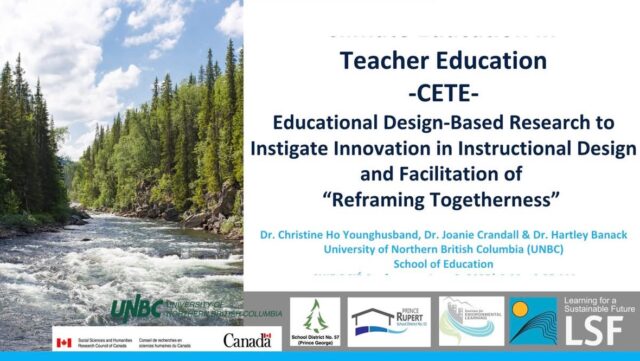
The second presentation was co-presented with a couple of my colleagues from the Climate Education in Teacher Education (CETE) research team. We presented on how we have “redefined togetherness” (aka., the theme of CSSE) and at a high level, described our research project and research methodology. I think the presentation went very well. It was well attended and well received. We have really mastered the planning process and presentation to tell our story as CETE that is representative, meaningful, and authentic. We may have recruited some folks to be a part of our design team. The third presentation was later that day (Day 2) in a RoundTable presentation. It was late in the day, so there were very few of us at this session. We combined the two tables into one and each presenter shared their work. I presented on some of the work done by myself and my friend on “uncolonizing assessment.” I did a small pilot in my EDUC 421 (Assessment and Motivation) course and learned from student reflection how the teacher candidates defined the Four R’s from Kirkness and Barnhardt (1991) in context to assessment, teaching, and their self-assessment. It was really powerful and I was taken aback as to how the teacher candidates used the Four R’s to guide their assessment plan and practice.
The final and fourth presentation was with CATE and I was presenting about a program evaluation of “in-situ” learning as part of my EDUC 421 course I teach with elementary teacher candidates. When I wrote the proposal, I was reflecting on the 3-years of which I had implemented a version of “in-situ” learning as part of my practice. And, I wondered if the learning experience was still worthwhile to continue even though I thought it was worthwhile to do. In response to proposal feedback, I went back to review the blog and page posts made by the teacher candidates as part of the course that commented on the “in situ” learning experience that reflected on their teaching at the elementary school or as a part of the course summary reflection. As usual, the reflections ranged in content and depth, but I was so overwhelmed by the articulation by these teacher candidates on their support, enthusiasm, and gratitude for the “in situ” learning experience to bridge theory to practice. I am so encouraged by their words such that I will return to this content again to do a thematic analysis to then formalize this program evaluation for publication.
I feel very grateful to do this work. Although I felt that the pandemic re-started my motivation to create a research program, the more I am understanding that I am deeply engaged in the SCHOLARSHIP OF TEACHING and ACTION RESEARCH. I am deeply invested in the practice as well as working with teacher candidates. Much like many of my reflections in this blog and the other with OpenETC, I am ALWAYS learning from my students. I feel so inspired by the gifts I receive from this work, but also how it fuels my love for the work that I do… and get to do. To conclude this blog reflection, I also want to share my love and joy for the connections I’ve made during the CSSE conference. Some connections are reuniting with folks (i.e., a former student in one of my graduate level classes, a new colleague and listening to their poster presentation of their dissertation, a mentor and friend to share their insights on effective teams, and giving a big hug and hello to another mentor who sought me out to say HELLO). Some connections are new ones (i.e., a professor and educator during my 4th presentation who is also a CATE dissertation winner, folks I met at a poster presentation, at roundtable, and in the hallway). I love these connections!!!
Written by Christine Ho Younghusband, June 08th, 2025 | Comments Off on Presenting at CSSE
 I will say, imposter syndrome is REAL. Understanding my worth is CHALLENGING. And, being ok with rejection is NORMAL. Wow. It has taken me a load of time to figure this out, but I guess that is the journey. I am sitting here on a Friday night, looking out my window and watching a thunder and lightning storm. The metaphor did not escape me. Big changes are a happening, and it’s taken me a long time to accept who I am, love who I am, and love the work that I do. I guess I am going to cite Brené Brown again to say that “I am enough.” I do remember the words of my supervisor saying, “we don’t give out doctorates to anybody… you’ve earned it.” (PS. may not be the exact words, but it’s close).