I love how this course is evolving. The student-led warm up activity this week was one that exercised and emphasized the Communication Core Competency as described in BC’s New Curriculum. The class was subdivided into groups of 4. Each group is given a picture. The first person who has the picture has to describe what they see to the second person. The second person has to draw what they perceive is being described within a 2-minute time limit. Once complete, the second person describes their drawing to the third person of the group. Finally, the process is repeated once again from the third to the fourth.
The activity resembled the “telephone” activity where messages can be and likely to be revised when told from person to person. The same could be and would be true with this activity. To my surprise, the students did very well. It was not an easy activity and it really relied on communication skills, listening skills, and a wild imagination. I could see how this activity could be used in the English Language Arts courses in K-12 as students are learning descriptive words to depict what they see. You could also use this activity over time (i.e. September, December, April, and June) to see progress in the communication competency over time. It was a fun, engaging, and interactive activity. I would do this in a mathematics class to demonstrate the importance of communication in math.
How does personalized learning and inclusive education connect to BC’s New Curriculum?
It’s about acknowledging each student and their strengths. It’s not about looking at homogenizing learners and grading them on how well they have conformed to the expected “learning outcome.” Personalized learning is about choice, interest, and exercising student agency within the framework of the course/subject area. This is not about creating 30 individualized curricula, but rather finding ways in which student can acquire and/or demonstrate their learning. This is where emphasizing curricular competencies and using content as the vehicle can create some flexibility for planning and personalized learning. Personalized learning acknowledges our differences.
How is your learning being personalized in this course?
Choice was offered for which participation activities students wished to facilitate. Choice was offered in what topic they wish to do their IGNITE presentation on, but it must relate to curriculum development and/or content highlighted in the course. Choice was offered for the final assignment.
How are inclusive practices being used in this course?
A safe learning environment is created. Student input and voice influences the direction of the course. Different opportunities for students to engage and participate. Tries to include and acknowledge all types of learners in class.
What are some possible benefits of personalized learning and inclusive education for student learning?
Students can exercise student agency and choice. Students learn more about their learning and what they are good at or interested in. Students feel like they are part of a learning community and we are able to celebrate our differences. We can achieve this within a common framework but can acknowledge our progress relative to ourselves and not others. Feedback would be personally relevant and applicable. All students would feel like their are part of the collective learning process. We are all learners (me included).
My Reflections
We are creating some momentum in this course. I am grateful for the early adopters for setting the stage for the rest of the class. This takes courage and I applaud them. With a solid foundation created by students, the student-led participation activities are getting better and better. I love that students create their own discussion questions from the readings. This week, many of the questions posed on personalized learning were somewhat similar, which I found interesting. There was some skepticism from the discussion. I would expect that when we as a collective of learners have been part of the 20th century learning model of achieving the same goal and being assessed that way. However, I am optimistic as I see topics of student choice as demonstrated in the Wild Card Activity. This week 2 students talked about the importance of drama (aka. action, student participation, or experiential learning) is valuable for students and the learning experience. We participated in an activity that involved math… from the 3 times tables to 7. With more time, we could have realized what the students were trying to convey.
I look forward to the upcoming weeks. We are approaching the halfway mark. I’m excited. We are moving towards assessment and evaluation and how that influences curriculum development and its implementation in context of BC’s New Curriculum.
Written by Christine Ho Younghusband, October 11th, 2017 | Comments Off on Communication Competency
Finally… I cross the stage… oh wait a minute, I took a detour mid-stage and avoided shaking the hand of the SFU Alumni President. Could this be a metaphor? Like, I’m not done? A denial of the end? I had full intentions of crossing the stage… no, I didn’t. Another lie. I never visualized myself crossing the stage. I did see myself sitting with faculty after being hooded, hence the detour. I guess I should have read ALL of the instructions inside my folder. I read the hooding portion and that’s it. All I had to do was follow my friend and classmate Carey Chute but I must have lost sight of him. Do not fret. I did get my alumni pin and my sudden detour did not make the video of the convocation LIVE, so I’m good.
The day was such a whirlwind. I caught the first ferry with my husband, picked up my kid from Starbucks at Horseshoe Bay who was coming back from a concert from the night before, then we went for breakfast at Denny’s before heading to SFU. I had to teach that morning before convocation, so I set my family free to roam SFU campus. I taught from 9:30am to 1:00pm then went down the hall to the Academic Quadrangle to get my gown. I barely got past STEP ONE of getting ready, but thank goodness for the volunteers who helped all of us to get ready for convocation. I was so glad to graduate and spend the afternoon with my friend and classmate Carey Chute. He supported me throughout the dissertation process. I was the keeper of Flat Carey from Dr. Michelle Nilson’s Class from the summer, How to Complete your Dissertation. He kept me entertained all afternoon.
My favourite moment was captured in a screenshot sent to me from my friend who was watching my convocation LIVE at home (see below). Don’t get me wrong… I loved getting hooded (even though Dan hit me in the face during the process… and said sorry soon after). It was this moment when I realized that I’m his equal… his peer. Dr. Alice Christine Ho Younghusband, EdD. Now that’s a mouthful. I’ve wanted this my whole life. My dad remembers me as a kid writing my name out on paper with all “my letters.” Sadly, I realized in my mid-40’s that my dad snooped in my room during my teenage years. That aside, the letters after my name are: Dr. Christine Younghusband, BSc, BEd, MEd, EdD.
I am proud of my alma maters, the University of British Columbia and Simon Fraser University. Now at the end of this chapter and my dream realized, I never thought I could do it. I never thought that I would get through my first degree (I don’t think that my dad did either). I never thought that I could get into or afford my second degree (but I became a teacher). I never thought I would get into my masters program due to my reading and writing phobia (but I got in and stayed in). And, well… my doctoral journey took 9-years. Again, I did not think I would get into this program (but I was accepted twice because I declined my first acceptance) and I never thought that my dissertation would be completed (but I finished and finished well). I am happy with my research.
“You don’t embark in higher education with hopes of being the same person.” Thank you Dr. Daniel Laitsch, my senior supervisor, for affirming this and THANK YOU for your belief in me, your guidance, and your gentle approach. From beginning to end, I took a 180. I felt myself turning around during the dissertation process such that I believe that I could not have completed my dissertation had I stayed teaching math. This is the irony. My dissertation is all about teaching, learning, and improving the learning experience of students. Moreover, another reason for pursuing a degree in educational leadership was to learn more about leadership in the field of education. Not only did I find solace in my research, I found solace in this professional learning experience of pursuing a doctoral degree. My reading and writing phobia is no longer. I answered my research question, one that I had for more than 20 years. And, I understand more about leadership.
So, what’s next? I’ve blogged about this since my oral defence and I continue to blog about it now. Acknowledging that I am a different person, it is unrealistic to believe that I would return back to teaching secondary mathematics… even though that’s where my heart is. My experience as a secondary mathematics teacher informed my writing as a Masters student, a Doctoral student, and now academic/researcher. I continue to teach at the university and I LOVE IT. That is very clear to me. I love to teach. I love honing my craft. I love facilitating learning. My students make my profession so wonderful and I would love to continue this. So, I may not be teaching in the Grades 8-12 classroom, but I am teaching at the university and influencing those who may teach in a K-12 classroom. This is powerful. I would also like to continue my research, travel, and present.
In the short term, I have a tonne of things to do. I have another study to complete, a research poster to prepare, and a conference presentation to make. In the meantime, I am also applying for opportunities to teach at the university and finding funding to further my research. This is a learning curve that I’m enjoying but also find humbling. You don’t know what you can or cannot do unless you try. I was also thinking about writing a book on MATH STORIES and my friend also wants us to co-author a book too. This is something that I never thought was possible… but it might be. “Look for and take opportunities that come your way.” More words of wisdom from Dan. Yes, I do overthink and want to make things happen that may not be aligned to my direction. Sometimes you have to reach out to figure out if something is within your alignment or not. There are no mistakes, only learning. This is the greatest human experiment… and I’m loving it.
Written by Christine Ho Younghusband, October 10th, 2017 | 2 Comments »
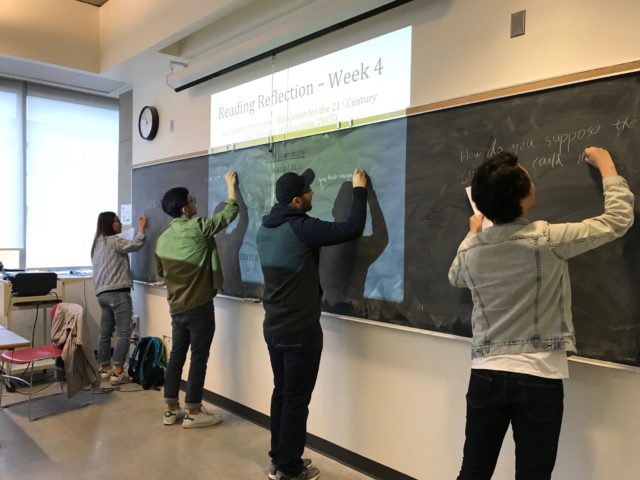
I love this photo. We are delving into BC’s New Curriculum and what it entails. In this course, students have the opportunity to sign-up for various participation activities. One of those activities involves reading reflections. This week, two students were responsible for the oral presentation of the article and two of them were responsible for the written summary. In this photo, these students are writing on the board questions they have for themselves and the class to discuss regarding the article we read. I love this.
I also loved how the student-led warm-up activity took a shift from “getting to know you” to “getting to know you better” with team building and problem solving. Students were divided into groups of 5 and given a handful of straws and a metre of masking tape. The challenge was to build a the tallest free-standing structure they could within a given time frame with the materials they were given. Wow. I could not have designed or planned for this better. This activity best exemplified the development of the Core Competencies of THINKING and COMMUNICATION. I was so impressed with the activity and final products.
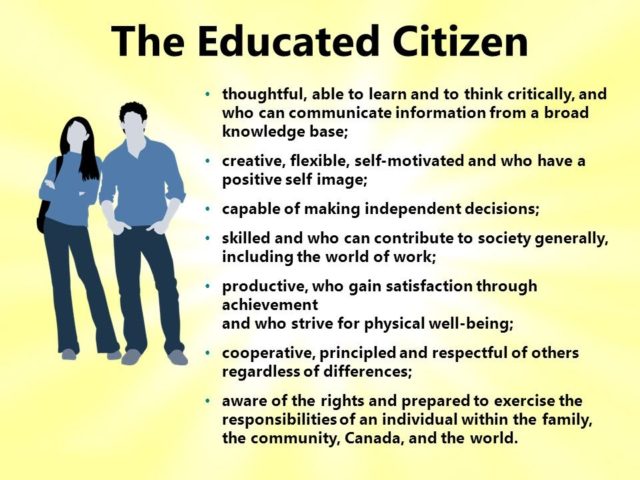
With the introduction to BC’s New Curriculum, the topic I wanted to focus on this week was the concept and policy of “The Educated Citizen.” The image below shows the main points of The Educated Citizen as seen in the Statement of Education Policy Order – Mandate of the School System of British Columbia (1989). BC’s New Curriculum (2016) and its development was focused on The Educated Citizen and how it can be achieved via the curriculum. It was believed that the curricula developed since the Education Policy Order (1989) did not satisfy the vision The Educated Citizen. Students were asked to reflect on what it means to be an educated citizen and if schools helped them to be one.
What does it mean to be an educated citizen?
For me, it’s the ability to think critically and creatively, to communicate with others effectively, and to find my passions, strengths, and interests. I feel that BC’s New Curriculum’s CORE COMPETENCIES help me to become an educated citizen.
In what ways have you met the criteria of BC’s Educated Citizen?
I feel as a 47-year old adult, I am an educated citizen. However, after my K-12 education experience, I am not certain if I satisfied all, if not some, of these bullets as seen above. I think I achieved the second and third last bullet… being productive and cooperative. I believed that I learned this from curling (aka. sport).
In what ways have you NOT met the criteria of BC’s Educated Citizen?
As an adult, I wished I was more consistent with “striving for physical well-being.” Going into that would be another blog entry, but I am left wondering where did I learn how to the rest of the bullets or did I learning it in K-12 and improved on it over time. I am curious what my students wrote in their journal reflections.
In what ways do you believe that BC’s New Curriculum will satisfy the characteristics of an Educated Citizen?
I mentioned this in my first response… I believe it will be the CORE COMPETENCIES. The curricular competencies feed into the Core Competencies and content serves as a vehicle to develop the competencies. Furthermore, student self-reflection, formative assessment, and Communicating Student Learning will compliment BC’s New Curriculum to help students to become metacognitive and understand their strengths, weakness, and appropriate learning adaptations to thrive in schools and beyond.
My Reflection:
My students remind me that students should be integral to their learning and leading their learning. They also remind me the power of the teacher as facilitator. The class spent much of their in class discussion on EDUCATION FOR ALL and what would the learning experiences look like for those with learning challenges if integrated with students how are university bound, for example. In essence, they were discussing and deliberating the idea of INCLUSIVE CLASSROOMS. Not only do these conversations inform me as to what we will be doing next class, but also it lined up to the Wildcard Activity chosen by the student this week. What did she present about? DIVERSITY. We discussed cultural diversity and cognitive diversity. I could not have planned that any better. I was so shocked how the student led activities, class content, and group discussions were interconnected. It seemed uncanny or serendipitous. Although it was not explicitly “planned” by me, the teacher, it was absolutely planned such that the topics and conversations about education, curriculum, and learning are natural fits. Too cool!
Written by Christine Ho Younghusband, October 05th, 2017 | Comments Off on A Full Class
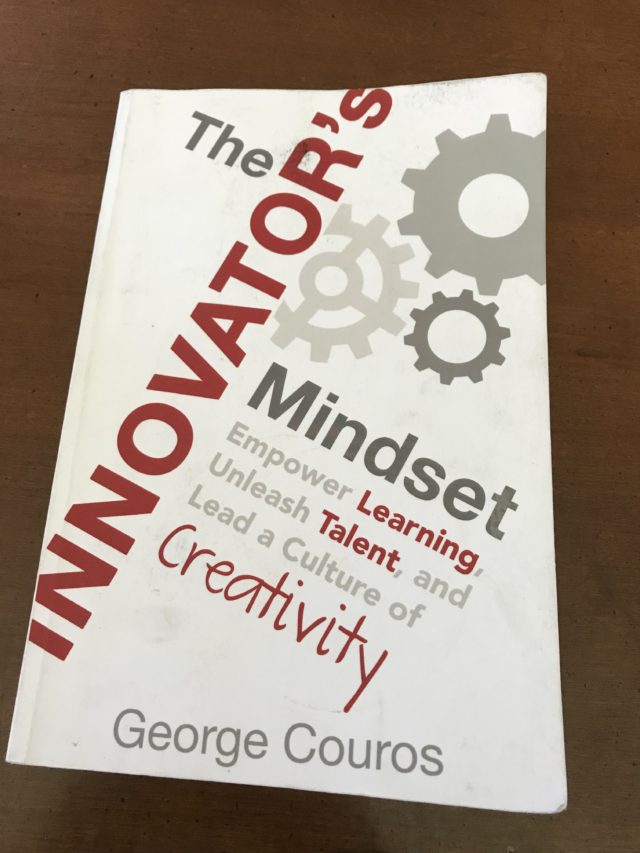
IMMOOC = Innovator’s Mindset Massive Open Online Course
I never done a MOOC before… nevertheless #IMMOOC. I am super excited… yet somewhat disoriented…but I’m catching up and here’s my first blog for #IMMOOC.
There is a weekly YouTube, a weekly Twitter chat, and blog prompts you can respond to. I missed the first YouTube event with Jo Boaler and now I’m “catching up” as mentioned watching the interview now. It’s so inspiring and in “my wheelhouse” in terms of math education and growth mindset. I am so glad that I took the time to listen to this interview with Jo Boaler. I feel so inspired… and yes, helped to me to make sense of (or add context to) the two blog prompts provided. I was wary about what I would write or if I would write a blog entry for #IMMOOC to share my thoughts and tell my story but Jo Boaler motivated me to do so. I loved what she had to say and I appreciated Jo Boaler’s story about her research. I feel validated and compelled to share. So here it goes…
WEEK 1 #IMMOOC BLOG PROMPTS & RESPONSES
Why is innovation in education so crucial today?
I loved it when Jo Boaler mentioned in the interview that curriculum is designed beautifully for the 1800’s, a time when we needed shop keepers who were able to count and calculate. BINGO. I am a former secondary math teacher and now teach a course at the university on curriculum development. I agree that curriculum serves a purpose and should reflect the current state of the world and possibly the future.
Jo Boaler speaks in the context of math education, but that is my area of expertise as well. Students need to go beyond filling out worksheets, answering questions from the textbook, and hoping to get the answer right. Testing is another problem and lack of formative feedback. Students have no idea if they are THINKING “correctly” (I use that term loosely) unless they check the back of the book… and that’s not good enough. I love the idea that schools (math included) should be a place where students can make mistakes, take risks, and play as part of their learning experience. I am aligned to this.
I’d hate to use the term “discovery learning” because that’s getting a bad wrap, but what I’d like to say is school is a place to LEARN ABOUT THEIR LEARNING. Innovating, creating, experimenting, tinkering, playing… whatever… help students to develop their metacognition, solve problems, and design something new. School should be more than just DOING and COMPLYING. That was very useful in the industrial model and factory style of learning… where GRADING learning was appropriate for assessment and evaluation of student achievement to see how well “students moved through the system” to become educated citizens. The letter grade symbolizes a “quality” of learning, but it’s a mish-mash of arbitrary measurements (e.g. testing, homework, work habits, behaviour).
This is where the fixed-mindset is established as students, teachers, and the system BUY INTO “the B-student.” This is what the industrial age needed and wanted… to create “quality widgets.” Today, we’re beyond that. We need and want our students to become global citizens… and, what does that look like? Innovation and growth mindset are integral to this “new” direction in education and all parts must align in this direction to make it happen for our students. So, I do get aggravated when I hear that students have to put their cell phones in a basket, memorize the parts of the periodic table, and learn from a worksheet. This is NOT how the real world is and we need to LOOK AT OURSELVES to determine what needs to change and then DO IT. Students should not be waiting to get out of school to start learning something that interests them, that celebrates their strengths, and that is purposeful and meaningful. Now is the time.
Talk about a time you dealt with adversity in education, and how you overcame it?
During the Twitter chat, one of the questions asked which quote was our favourite from the Innovator’s Mindset book. The one that resonated with me is situated early in the book on page 47 that says, “Great educators can work within the constraints in the system and still create innovative learning opportunities for their students.” I wholeheartedly believe this and KNOW that there are some great educators out there doing incredible and innovative things with their students in their classes… but there are very few. Meaning, innovation and risk taking in schools is not a cultural norm.
I love how Jo Boaler says that we need to CELEBRATE MISTAKES and CELEBRATE RISK-TAKING. I do believe that we get too caught up in the “the rules” or perceived rules or ways of being that teachers don’t bother, don’t know, or feel fearful to try. Furthermore, I love how Jo Boaler is not a fan of homework such that she would “gladly to get rid of all homework” because it’s an equity problem and most kids feel defeated with homework. I would absolutely agree with this. We need to teach differently. The final comment that made an impression on me with Jo Boaler was her comments to POLICY MAKERS… “We have to free up teachers”… “that’s when they start seeing connections.”
Leaders must also be “educated” on what it means to lead innovation in education. When I left teaching in public schools, I felt like I was being forced back into a box. The image of this lived experience was “me oozing out of my chair.” I couldn’t fit back into the chair. I wanted to grow. I wanted to experiment. I wanted to play. Slowly but surely I was put back into my room, denied opportunities I wanted to be a part of, and I felt like a “troublemaker” or out of place with my teaching practice. Over time, I was feeling disconnected and misaligned to my practice. I was becoming defiant and my focus was more about questioning why versus innovating with my students. So, I quit my job.
That was 7-years ago and it was not an easy journey back. I completed my dissertation and doctoral degree. I became a public speaker and facilitated many workshops and presentations. And, I was part of BC’s New Curriculum and its development. I restored my love of public education as a school trustee and gained a new understanding of how policy influences practice and student learning. I had the opportunity to return back to teaching as a sessional instructor and I love how I am able to be creative, innovative, and fun-loving in the classroom again. Yes, there are constraints teaching at the university, but also an academic and pedagogical freedom I adore and respect. I feel very lucky.
My Biggest Take-Away – Week 1 – #IMMOOC
When you push against what is traditionally known, you will get push back.
This is huge. That’s the underpinning of how I felt… and sometimes continue to feel with my former teaching practice, my research, and now educational leader. The solace that this gives me is overwhelming. Since leaving teaching in public schools I tried to avoid “the push back.” It’s not a good feeling. You feel isolated and alone… like you’re doing something wrong. In hindsight, this is counterintuitive. If you want to make change, accept that there will be push back. YEEEEESSSSS!!! Jo Boaler’s story was validating and inspiring. Thank you. I have attached Jo Boaler’s YouTube interview below. Enjoy!
#IMMOOC , Season 3, Episode 1 – with Jo Boaler (Twitter: @JoBoaler)
Written by Christine Ho Younghusband, October 05th, 2017 | Comments Off on Intro to #IMMOOC
I love this picture of my baby… from 14-years ago. Look at her little hands and monster feet… and her itty bitty nose. Super cute. I must admit, giving birth was the toughest thing I had to do EVER in my life. There were not enough prenatal classes for me to make this a natural and straightforward experience. I pushed like no one has pushed before (i.e. popping several blood vessels in my eyes… it was not pretty). She was suppose to be born on the 28th… and yes, she was born on the 29th. I was not prepared for this.
Completing my dissertation was a probably the second most difficult thing I have ever experienced (thus, giving birth still takes first place). Instead of being pregnant for 9-months, I was a doctoral student for 9-years. Ugh. As much as I wanted the dissertation to finish, I thought that the process would never end. I can see why giving birth and completing a dissertation are similar. You have something growing inside you… you write and revise it to finally defend it (aka. you’re working through the contractions and finally pushing)… and voila, you finally submit the “real” final draft of your dissertation to the university library (aka. your beautiful baby is placed into your arms). Now what?
When my daughter was born, I remember thinking that now I have someone completely dependent on me. My mind had shifted. I was someone else. I had unrealistic expectations of returning back to the person I was before she was born. That was a weird place to be. It was much like denial, in many ways. Maybe it was. Well, that’s how I feel about my dissertation. I have an obligation, a message to share about teaching and learning. However, I must admit, I catch myself looking on the Make a Future website focussed on the math teaching positions believing that’s where I am suppose to be.
Even today at the shoe store, I bumped into two former colleagues who congratulated me on completing my doctorate. I thanked them, but the classic follow up question of “what’s next” came up. I would like to believe I’m in a crossroads, but really, I think I’m in denial. I know that I love to teach math, but that’s where I came from. It’s not that I am walking away from it, but really it’s what I have learned from it that matters and what I can do with that information to help with student learning. I love data analysis (more than I should) and I love looking for and finding patterns in the context of K-12 education.
I have another study to complete… and policy to review and revise for two organizations. These are opportunities I cannot pass up or overlook. Furthermore, I am teaching at the university, learning from my experiences, and sharing those experiences with prospective teachers. That’s more than what I had hoped for. I love teaching and the creativity that’s involved with it. I enjoy research and the idea of being published gets me super excited. As much as I think that being back in the math classroom is a “solution,” the reality is, I’m preparing for the next step. It’s not going to be an easy one, nor will it be straightforward and immediate. I’m starting all over again and it’s OK to be at a NEW beginning.
I am not the same person and I don’t understand why there is a part of me that wants to be. The future is unpredictable, but what I have to come to grips with is, I am an “academic entrepreneur.” I’m not sure if I’m coining this term, but I am an academic and I need to create, sell, and promote my ideas. This is where creativity, vulnerability, and courage are essential to my future success. Now that’s scary. But if I really want to honour where I came from (aka. teaching secondary math), then I need to forge forward and take the entrepreneurial leap, make partnerships, and embark on new research. Much like my baby, my research will grow and develop over time, but also it will get better.
Written by Christine Ho Younghusband, September 30th, 2017 | 2 Comments »
Oh my goodness… it was so nice to go back outside to learn. The start of today’s class reminded me of EDUC454 (Quantitative Approaches to Environmental Education) I taught during the summer. We were outside for almost every class. I loved it… rain or shine. Come to think of it… I don’t think it ever rained. I could be wrong… but I loved learning outside. In EDUC471, we were outside for the warm-up activity. The hallway was ok last week, but we had to dodge foot traffic during the activity. Those walking through were a distraction, so I loved the whimsy of choosing to go outside. It was a beautiful day, as you can see. I enjoyed the activity. We had to shake hands, introduce ourselves, and play rock-paper-scissors. If you win, you’re the leader. If you lost, you’re the follower. We played three rounds of the game. All I could think of was the MATH… what a nerd. I liked meeting new people, but also I LOVED the competition. Learning outside is joyful.
This week’s reflection questions:
Looking at your school career and curriculum, what do you think you are prepared for (post schooling)?
When I had finished my undergraduate degree in chemistry and mathematics, I thought I was trained to work in a lab. That said, I took my major and minor so that I could teach secondary math, science, and chemistry. The best skill I learned in high school that best served me throughout my life and career was typing. I wished I followed through on that course. I dropped out halfway through the course. Generally, I believe that my schooling from K-12 to graduate studies have taught me how to think, but the notion of “getting a job” served as a distractor such that I could not fully learn for fun. It seemed more geared for function, which in many ways was not as fun.
What experiences have you had while in school that recognized and focussed on your strengths?
Hmm… this is a good question. Admittedly, I focused much of my learning (or schooling) on addressing my deficiencies. I was “burdened” by my reading and writing abilities. For me, it was my sense of “English Language Efficacy” that was my nemesis in school. It was always a perceived barrier and I could never believe that I could make it to the “next step” (i.e. university, faculty of education, and graduate studies). But look at me… I’m done my doctorate and wrote a dissertation to my disbelief. Many of my students felt the same way about math. I’m not sure if I had realized my “strengths” in high school or in post-secondary education. I think that I learned more about my strengths from competitive CURLING, as a student. I am learning more about my strengths now.
What do you think would need to change in the current curriculum to prepare students for the 21st Century?
I would love to see more choice in learning so that students can discover their strengths but also exercise student agency. Furthermore, I would love to see learning experience more personally relevant and driven by intrinsic goods (aka. interest or passion) rather than extrinsic goods (e.g. grades and course credit). I believe that learning can be and should be FUN. I don’t mean easy… but the “act of learning”… engaging and collaborating… creative and critical thinking… are the source of joy. And from this acquisition of 21st Century Skills (and mindset) via learning content of interest, would lead to a more meaningful learning experiences that would meet the needs of the job market. It is not one or the other, but what foot you lead with that matters.
MY REFLECTIONS
Oh my goodness again… the managing of the logistics of getting people signed up for activities and understanding how to access information for this course has been frustrating and time-consuming to say the least. Having to reprimand students is not my favourite thing to do as a teacher, but when the course is designed such that all of us are interdependent, one person who is not aligned to what is expected disrupts the learning for the whole class. Once again, maybe I should sit in another class (without being noticed) to understand what these students have experienced in their other courses. On the one hand, yes… students are getting graded as individuals… but on the other hand, we are all members of this learning community and we are are going to succeed together. This might be a mindset shift. I’m not sure, but what I know for sure is, we are going to get the BIG IDEA at the end of the course. I feel optimistic and I look forward to our next class. We are going to look at BC’s New Curriculum. I can’t wait. Exciting times!!!
Written by Christine Ho Younghusband, September 27th, 2017 | Comments Off on Outside Again
What an amazing experience… presenting at TEDxWestVancouverED. Yes, it was a 4-minute presentation… which had a lot of content in such a short time frame. The title of my talk was ALIGNMENT… my message was FIND YOUR PLACE. It was fun for me to connect my love for mathematics and pattern making to systems thinking. The underpinning of my presentation is “whatever we want for students, we should want for ourselves”… and “it will take all of us” to not only “make ripples in the system”… but together… “make waves.” I loved that I used the Russian Nesting Doll as a metaphor for my TEDx Talk. Thank you Sandra Cunningham for letting me borrow your dolls and take pictures of them as seen in this photo. Thank you to all of the volunteers and crew who made this event possible. Thank you to the awesome presenters (I am so inspired). And, thank you to my PLN. I could not have done this without you. You are the best!!!
Doing a TEDx presentation was more like giving a mini-dissertation defence. You need an idea that you are passionate about. Then, you are given a time allotment to get your message across. On the one hand, you are motivated to inspire the audience with what you have to say, but also you are asked to call the audience to action. A CALL TO ACTION. From passion to message to action… and thank goodness for the experience and expertise of Craig Cantlie, a school principal from the West Vancouver School District, who facilitated our “learning” to get prepared for the TEDx event. We spent almost a year from application to presentation to GET IT DONE. I needed that time… to make my thoughts and presentation coherent, purposeful, and meaningful… from what I had to say and what images I wanted to show to compliment what I had to say. I spent hours rehearsing my script. I was revising until the last minute. What I had to say underwent major revisions after rehearsal the day before the event. More rehearsing. No pressure.
Oh… the power of FORMATIVE FEEDBACK. Thank you Craig… It sounds too much like a lecture. Inspire them. Have fun. Be joyful. Hmm… very good points, hence the major revisions. Well, I did not change the meaning of what I wanted to say (or the PowerPoint slides), but I did change my approach. Interestingly, it was an easy change and it FELT GOOD. It was meant to be. In the end, I was satisfied with my presentation. Yes, it took me a moment to use the clicker to get my PowerPoint started because I think I am too conditioned for IGNITE presentations and automated slides. Aside from that and struggling with the clicker in general (I think I lost 20 seconds to clicking), I believe I said what I had wanted to say. Even though I find myself still rehearsing in my head post TEDx and I’m not sure what I had said. I don’t remember. What a strange phenomenon. That said, what pleased me the most was the immediate feedback from my friends in the audience. Some said that they loved the metaphor of the Russian Dolls, others said that it was nothing like what they had expected, and others said they just LOVED IT.
TEDxWestVancouverED was one of the best experiences I had. I was humbled by the work that went into preparing my presentation and I was honoured to be presenting with an awesome group of presenters. Everyone at TEDxWestVancouverED… participants, presenters, and volunteers… were INCREDIBLY POSITIVE and encouraging. Thank you. I appreciated the change in formats from an audience of 400 to 100 with small tables for the audience to sit around. I loved the PADLET coffee, SWAG bag gifts, and FOOD from Loblaws. The intimate nature of the event created a professional learning environment where you can connect deeply with your PLN and meet people. Others also participated in a socratic circle during the breaks, but of course, I opted to chat with friends. Best of all, I loved the “collective painting” activity. You can see examples of them on each side of the screen as seen in the photo. Presenters made paintings, but so did the participants. It was a beautiful metaphor for togetherness and vulnerability. It was awesome.
It’s a full house. All but one student attended this week’s class. 38 students are enrolled in this class, which has a class capacity of 35. As the deadlines for course changes approach, I am fielded with several emails regarding enrolment. Compelling stories and I allowed several students to enrol but I had to say NO to student number 39 and future requests. It’s a compliment when students say that they took this course because they read my blog or it was recommended to them, but I worry about the quality of education I can provide when the class is over capacity. We just had enough seats for those who arrived to class. I do have one more seat, my chair, to offer to the 38th student for next week. I do like it when everyone comes to class. As you can see in the picture above, we used the hallway (aka. available space) to facilitate our first warm-up activity.
It was so nice to get started with EDUC471D100 this week. This week we read an article on Curriculum Theory and Practice. Based on the reading, our discussions, and our past experiences, we are asked to answer the following reflective journal questions:
What was your learning experience like when you were in K-12 schools?
I know that I am the one asking this question, but I think it’s a good question. What do I remember? Admittedly, my learning experience in K-12 schools was somewhat uneventful. I loved my “drafting” class and regret dropping out of my “typing” class (whoa… I am totally dating myself). I really liked my Chemistry 11 and 12 classes. I remember Grade 2 and 4, but not for good reasons. I would say that I struggled with reading and writing (now, not the case… that took years to resolve). What I remember most about my K-12 experience was CURLING. I used to compete at the provincial level. Otherwise, I would spend most of my time doing what my teachers asked me to do (aka. learn).
What is your learning experience like at university?
I will say that my learning experience at the university was a struggle. At least, that’s what I remember. I took first year science because I liked Chemistry so much in high school. I failed Math 100 in my first year and it’s been a journey ever since that experience. I did retake Math 100 and got an A but my scheduling to be a Chemistry major was offset because I did not pass Math 100 in my first term. A long story made short, I did finish my degree in Chemistry with a minor in mathematics. What I recall is trying to do what I thought I needed to do as prescribed by the professor. It was CURRICULUM AS SYLLABUS and product. My most favourite course was CHEM412, which was my chemistry project when I had to quantify a certain chemical in dish soap. I loved that course. I did not return to that kind of learning until my “PhD in Education.”
What role does curriculum play in your learning experience? In schools?
The curriculum is the WHAT. What are we suppose to learn. We have student agency to select what major we would like to study, but whatever direction we choose, there is curriculum that suggests what we are suppose to know and CURRICULUM AS PRODUCT tells us how well we learned it. As a sessional instructor in education, I am drawn to the idea of facilitating CURRICULUM AS PROCESS or praxis. What does it look like when students are a part of the co-creation of knowledge? I believe that this is what BC’s New Curriculum strives for. The curriculum has content but also competencies. Competencies, in my mind, are geared towards curriculum as process and still “prescribes” what students should learn. The curriculum is STATIC… nothing happens to it anyway until it is “delivered” or taught to students. Thus, factors such as assessment and evaluation, quality of teaching, and mindset would influence how curriculum is perceived.
MY REFLECTION
I am an experiential learner at it’s best. I like to be learning as I am doing. As my students are stumbling along with PARTICIPATION ACTIVITY SIGN-UP and it’s limitations using Canvas, I am stumbling along planning and preparing for this course. This is not to say that I am not able to facilitate their learning and design a course that address curriculum development, what I am saying is the momentum of the class dramatically changes when there are 12 students more than what I had last term. Group discussions take more time, mobilizing our class to play/learn in the hallway takes more time, and dealing with technology also takes a bit of time. Sadly, I had to assign homework this week to get what was intended accomplished. Albeit, it was a TEDx video and our journal reflection, but sometimes I like to offer class time to sense-make and reflect together. That said, it’s also an opportunity to implement some of the blended learning strategies I learned at the UBC T-BLE workshop this summer as well. It’s only Week 2 and we are learning the rhythm of our course and building our learning community. It was an incredible Week 2. Those who implemented the participation activities this week were AWESOME and met expectations. The group discussions went very well too. It was an excellent class of EDUC471D100… I may have fallen in love with this class already.
Written by Christine Ho Younghusband, September 20th, 2017 | Comments Off on A Full House
I love this photo. This is where I live. It’s on the Sunshine Coast, BC at Davis Bay. Look at the sky, the ocean, and mountains. It’s absolutely gorgeous. The photo makes me feel optimistic and hopeful. There is also a person standing out there on a float-pad. It’s a metaphor of where I am. There is a sea of possibilities and I am looking for my alignment. After writing my last blog entry, Back Here Again, I ended the blog looking forward to the next 12-weeks. I am transition. My daughter is back to school. And, I am in the driver seat to figure out what’s next for me. Admittedly, it’s an odd feeling when my lifetime goal was to complete a PhD. Now that it’s done, it’s time for new goals.
I did not realize the process post-dissertation. My oral defence was on August 17th, I submitted my revisions on August 18th, and they were approved on August 21st. I submitted my final draft to the SFU library online on August 21st. On September 7th, my thesis intake was completed by the SFU Library and TODAY, September 12th, the “Senate has awarded [my] degree of Doctor or Education.” Convocation is on Friday, October 6th. I can’t wait. This break is good timing nonetheless. I started teaching at SFU-Burnaby Campus on Friday mornings and I used this time to reflect to figure out what’s next.
When I was doing my dissertation, thinking about what’s next was a distractor. It took time and effort to think about what’s next and not to think about it. I had to do the latter to focus on my research, get things off my plate (even though I may have loved doing certain things), and complete my dissertation. Mission accomplished. Now, I feel like I’m trying to force something to happen. This is not a good place… because, nothing happens. I was reminded by my friend today, hence the inspiration to blog, that SERENDIPITY plays a role in what’s next. Whether if you know it or not, everything that you do is aligning itself to what’s next. You have to allow it to happen and LET GO.
What I mean by “let go” is not a passive role of “doing nothing” or “hoping for the best.” It’s bigger than that. You just can’t force things to happen. And if you do, it was not meant to happen and it’s doomed for failure. Alignment is key to making things happen… but letting things happen. You have to do what is within your reach and works towards what you want or intend to do. When I look back… and I’m looking way back… I find it odd how everything I have done forms a straight line to where I am. At the time, it may have felt like chaos, incongruent, and uncertain… but now I see it was meant to be. You have no idea when one relationship, one project, or one event can transform your life.
I am humbled by serendipity. I am also humbled by TRUST and intuition. Sometimes you have to listen and do what you believe is the right thing to do even though you may have no clue where it’s heading. That’s OK. This is another form of letting go. You don’t have to know. As long as it feels good and you’re aligned to that person, direction, or way of being… then do it. Misalignment takes work to maintain and for what purpose? What feels right for me for the next 12-weeks is to continue writing academically and write articles to be published. I also need to complete another study I am working on and write that paper up. Finally, I need to complete writing my CV, educational philosophy, and cover letters and apply for jobs. I’m at a new beginning. It’s time to apply and publish.
Written by Christine Ho Younghusband, September 12th, 2017 | Comments Off on Apply and Publish
It’s official. A hat-trick of teaching at SFU as a sessional instructor. Honoured. I return back to teaching EDUC471 – Curriculum Development: Theory and Practice. It’s a morning class instead of late afternoon and I’m in the main building, not in a portable building. I am feeling pretty lucky. As promised to my students, I have committed to writing a blog entry as they are asked to write a reflective journal each week. This week is introductions. Who am I? Why am I here? What do I expect to learn in this course?
Who am I? I am a former secondary mathematics teacher with 16 years of experience teaching in public schools. I am also a secondary science too. I have taught Math 8-12, Calculus 12, Science 8-10, Chemistry 11/12, and Earth Science 11. Currently, I am a sessional instructor at SFU and school trustee on the Sunshine Coast. I have facilitated workshops on BC’s New Curriculum, been on the Math K-9 Curriculum Development Team, and tutored mathematics from my home. My greatest accomplishment is finishing my Doctor of Education degree in Educational Leadership at SFU. I successfully defended on August 17, 2017 and will be participating in convocation in October. I can’t wait.
Why am I here? The official question asked to my students was why did he or she choose to take EDUC471 as a face-to-face course on campus. For me, you apply to what courses you wish to teach and hope that you are selected to teach at least one of the courses you’ve applied for. I say that because I taught EDUC454 last term and did not initially apply for that course, but loved it in the end. It’s amazing how life leads you in a particular direction and you have no clue where you are going but realize that you were meant to do it. I learned a tonne in EDUC454. It’s an honour to have EDUC471 again. Many professors I speak to love teaching EDUC471. It was the first course I’ve taught at SFU and feel that this is an excellent opportunity to revisit the course again.
What do I expect to learn? I hope to learn more about the students in front of me and how I can hone my craft as an instructor to provide a learning experience that is engaging, thought provoking, and interactive. The learning intentions are not as specific as EDUC454, which focused on environmental education and quantitative approaches. I hope not to fall into the trap of doing what I had done last year. It’s not about “reinventing the wheel” but it’s more about being a critical friend (to self) and identify what didn’t work out that well last year and how I can make it better. I have already found myself “in a trap” and can’t seem to see a way out of it. It’s nor here or there, but it could be better. I will have to think about that one. I might make some adaptations.
My Reflection
Overall, it was a really good first day. I’m always curious about not having a full attendance on the first day but those who did attend are pretty keen about getting started. I think about sitting in someone else’s class to see how it’s run because my students seem to get confused soon after my first class about the makings of my course. We spend the entire first class going over the detailed syllabus and Canvas. I appreciate their questions, but I wonder what I am doing (or not doing) that is not clear. This will be my test this term. How much am I willing to flex with the design of my course.
I find it very interesting how many emails I have received over the last few days. Some emails are from students trying to get into the course. Some emails are from students looking for some clarification on assignments and activities. While other emails are about the course itself and where to find things. This class is certainly not shy about asking questions… which I like. They are also willing to “break the rules” or ask for changes… which I like as well. What I have to consider is how I will answer them and where my boundaries lie. It’s not possible to be accommodating to everyone, even though I may want to be. I will do my best, but it will remain a balance as to who leads the course.
I am glad to be teaching this term at SFU. It gives me some time to figure out my next steps and see what’s out there that is a best fit for me at this point in time. Life now not as a student means to get out there in the big world “to make a difference.” Teaching makes a huge difference in a student’s life. I need to determine what kind of impact I would like to make on student learning. My lifelong goal was to complete a doctorate degree. All that I have done has led to this achievement. Now that I am here, I have to figure out what’s next. I look forward to this and the next 12-weeks with EDUC471.
Written by Christine Ho Younghusband, September 11th, 2017 | 1 Comment »


 I never done a MOOC before… nevertheless #IMMOOC. I am super excited… yet somewhat disoriented…but I’m catching up and here’s my first blog for #IMMOOC.


